Few images are as closely associated with classic cartoons as a bright red bundle of TNT with a fuse burning toward disaster. In the world of **Looney Tunes**, explosives became almost as recognizable as Bugs Bunny’s carrot or the Road Runner’s “beep-beep.” TNT helped create the exaggerated, impossible style of comedy that defined Warner Bros. animation, where characters could survive enormous explosions, shake off the soot, and return moments later for another gag.
TNT stands for **trinitrotoluene**, an explosive developed in the nineteenth century and widely used for military and industrial purposes. In real life, TNT is obviously extremely dangerous. Looney Tunes transformed that dangerous object into something completely different: a visual punchline. A stick or crate marked “TNT” immediately told viewers that something ridiculous was about to happen, usually to the character who had carefully planned the explosion in the first place.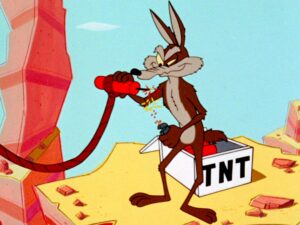
The connection is especially strong in the **Wile E. Coyote and Road Runner** cartoons. Wile E. Coyote constantly develops elaborate schemes to catch the Road Runner, frequently using explosives, detonators, rockets, cannons, and other dangerous devices. His plans almost always backfire. Instead of blowing up the Road Runner, the explosives tend to detonate beneath the Coyote, beside him, above him, or at exactly the wrong moment.
TNT worked particularly well in these cartoons because audiences could understand the joke almost instantly. Animators did not need several minutes of explanation. A wooden crate stamped “TNT,” a plunger-style detonator, or a bundle of red sticks with a burning fuse established the situation immediately. The audience knew there would be an explosion. The comedy came from wondering how the character’s carefully constructed plan would go wrong.
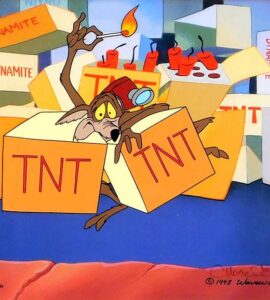 Explosives also fit perfectly with the exaggerated physics of the Looney Tunes universe. Characters regularly fall from cliffs, get flattened by enormous objects, run through walls, and survive events that would be impossible in reality. A TNT explosion might leave a character covered in black soot, missing some fur, or standing inside a smoking crater. Seconds later, the character would be back to normal. The explosion functioned more like extreme slapstick than realistic violence.
That tradition extended far beyond Wile E. Coyote. **Bugs Bunny, Daffy Duck, Yosemite Sam, Elmer Fudd, and other characters** appeared in stories involving bombs, gunpowder, cannons, and explosives. Yosemite Sam in particular was an ideal character for explosive humor because of his short temper. When a plan involving gunpowder went wrong, the explosion often became a physical representation of the character’s already explosive personality.
The cartoons also developed a recognizable visual language around TNT. Explosives were often conveniently labeled with enormous letters so viewers could immediately identify them. Fuses burned slowly enough for characters to notice them, panic, and desperately attempt to stop the inevitable explosion. Detonator plungers created another opportunity for comic timing, particularly when a character pushed the handle expecting an explosion and nothing happened until the worst possible moment.
One reason these jokes remained memorable was the extraordinary importance of **timing and sound effects** in Looney Tunes animation. A character might stare nervously at a bomb while the fuse grows shorter, creating suspense before the explosion. Sometimes there would be an unexpected pause. Then came the enormous blast, followed by silence and a visual reveal of the unfortunate character. The sequence was carefully choreographed so that the explosion became the punchline rather than simply a loud event.
There is also an interesting historical element to the cartoons. Looney Tunes shorts were produced during decades when dynamite, TNT, military weapons, and industrial machinery were much more visible in popular culture than they are today. The animators borrowed familiar objects from the real world and exaggerated them into absurd cartoon props. Over time, the red bundle of explosive sticks labeled “TNT” became such a common cartoon symbol that generations of viewers recognized it even if they had never encountered an explosive in real life.
Ultimately, TNT’s relationship with **Looney Tunes** is less about explosives themselves and more about the series’ approach to comedy. The cartoons took dangerous situations and pushed them so far beyond reality that they became absurd. TNT provided suspense, visual humor, dramatic sound, and an almost guaranteed opportunity for a character’s plan to spectacularly backfire. That combination helped make the exploding TNT bundle one of the enduring symbols of classic cartoon slapstick and an unforgettable part of the Looney Tunes legacy.